Political Invisibility and Mobilization by Selina Gallo-Cruz
Author:Selina Gallo-Cruz [Gallo-Cruz, Selina]
Language: eng
Format: epub
ISBN: 9780367856939
Barnesnoble:
Publisher: Taylor & Francis
Published: 2020-12-31T00:00:00+00:00
Visibility and threat during the wars
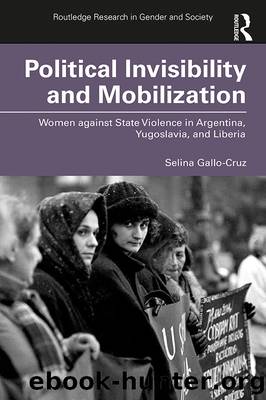
Women carried their struggles for status into the wars of the 1990s. A deepening fragmentation among national and regional fields characterized the conflict. In practice, this meant that various nationalist groups opposed various other nationalist groups and ethnic minorities within and across the lines of contention. The ways ethnic groups were spread throughout each of the republics complicated the establishment of geographic and political boundaries. The Serbian regime believed that two groups of actors posed the greatest threat to its goal of an expanded, independent Serbian state: 1) those who opposed drawing new national boundaries within the former Yugoslavia, and 2) those who opposed the war. The Serbian regime also labeled men who resisted military service and conscription enemies of national integrity. While some women actively opposed the war, all were potential âmothers of nationhood,â and the aggressors didnât consider them to be serious political threatsâunlike male dissidents, the women were politically invisible, lacking perceived relevance to the ideological epicenter of conflict, and from this irrelevance followed disregard and disrespect. Or women were expected to pledge allegiance to the growing nationalism of fragmented groups, leaving few alternatives for women between dedication to the Serbian state and a dissidence for which they would experience disdain and disregard (Yuval-Davis 1997).
In late 1989 and throughout 1990, multiple republics (and a province) began making moves toward their own independence. Slovenia adopted a number of amendments to the Constitution of the Socialist Republic of Slovenia in September of 1989. Leaders from the ethnic Albanian majority in the province of Kosovo held an assembly (without Serb and Montenegrin deputies) in July of 1990 to declare its independence from Serbia. In December of 1990, Croatian President TuÄman declared a right to national sovereignty. Meanwhile, tensions were erupting among Serb, Bosnian Muslim, and Croat parties over the fate of Bosnia-Herzegovina (PavkoviÄ 2000). A transfer of representative power and governance from Serbia to Croatia and other republics should have occurred in 1991 but the Serbian president attempted to block this, for fear of secession. After majority-backed votes to secede, Slovenia and Croatia declared independence anyway. A ten-day war broke out between Serbia and Slovenia. When Serbian forces were unable to push past Slovenian protection of its borders, their aggression shifted to Croatia, and threatened to spread to Bosnia-Herzegovina (Baker 2015; Lampe 2000).
Several groups opposed the wars. The most vocal were peace organizations and trade unions. As the Yugoslav Peopleâs Army began to conscript young men for the war, parents quickly mobilized against conscription, with 10,000 descending on the National Assembly in Sarajevo. As noted previously, several thousand parents, mostly mothers, went directly to Belgrade to protest the Yugoslav Department of Defense and Army Chief of Staff, but officials would not meet with the parents. The mobilized parents were supported by the Center for Anti-War Action in Belgrade and thousands of mothers in Yugoslav cities. All republics except Serbia and Montenegro responded positively by ceasing to send conscripts to the Yugoslav National Army, which temporarily obstructed war efforts.
Download
This site does not store any files on its server. We only index and link to content provided by other sites. Please contact the content providers to delete copyright contents if any and email us, we'll remove relevant links or contents immediately.
The Secret History by Donna Tartt(19103)
The Social Justice Warrior Handbook by Lisa De Pasquale(12197)
Thirteen Reasons Why by Jay Asher(8919)
This Is How You Lose Her by Junot Diaz(6894)
Weapons of Math Destruction by Cathy O'Neil(6284)
Zero to One by Peter Thiel(5808)
Beartown by Fredrik Backman(5768)
The Myth of the Strong Leader by Archie Brown(5513)
The Fire Next Time by James Baldwin(5454)
How Democracies Die by Steven Levitsky & Daniel Ziblatt(5225)
Promise Me, Dad by Joe Biden(5157)
Stone's Rules by Roger Stone(5091)
A Higher Loyalty: Truth, Lies, and Leadership by James Comey(4967)
100 Deadly Skills by Clint Emerson(4932)
Rise and Kill First by Ronen Bergman(4797)
Secrecy World by Jake Bernstein(4756)
The David Icke Guide to the Global Conspiracy (and how to end it) by David Icke(4723)
The Farm by Tom Rob Smith(4517)
The Doomsday Machine by Daniel Ellsberg(4493)
